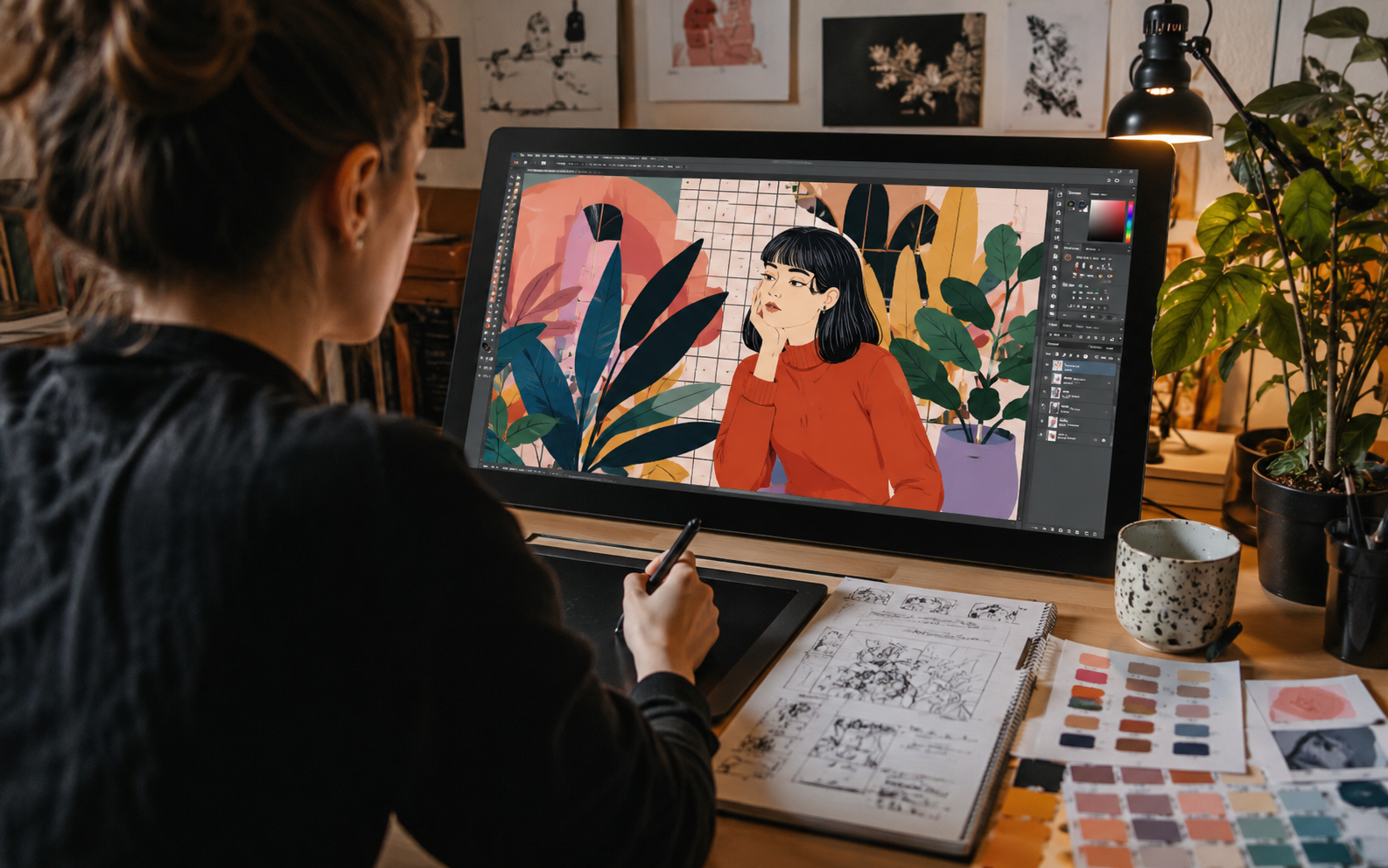
Open any major newspaper or magazine today — or more likely, its digital edition — and you will notice something different about the illustrations. Gone are the safe, predictable stock-illustration aesthetics that dominated editorial design for much of the 2000s and 2010s. In their place is work that is bolder, stranger, more personal, and more willing to challenge readers than to simply decorate the page.
This shift represents a genuine changing of the guard in editorial illustration. A new generation of illustrators, many of whom built audiences on social media before ever receiving a magazine commission, is bringing fresh visual vocabularies to publications that desperately need them. The result is some of the most exciting editorial art in decades.
What Changed
Several forces converged to create this new wave. The most obvious is generational turnover — art directors who came of age with graphic novels, indie comics, and internet art culture are now making commissioning decisions at major publications. Their visual references are different from those of their predecessors, and they are more willing to take risks with style and content.
The economics of illustration also shifted. As budgets for editorial photography shrank and the demand for original visual content grew, illustration became an increasingly attractive option for publications. An illustration can communicate an abstract concept — income inequality, digital surveillance, political polarization — in ways that photography often cannot. And a distinctive illustration style gives a publication a visual identity that stock photography never could.
Diverse Voices, Diverse Styles
One of the most welcome aspects of the new editorial illustration landscape is its diversity — both in the backgrounds of the illustrators and in the range of visual styles being published. The monoculture of the vector-illustration era, when every editorial image seemed to come from the same digital template, has given way to a kaleidoscope of approaches: hand-painted gouache, rough pencil sketches, collage, 3D rendering, textured digital work, and hybrid techniques that combine multiple media.
This stylistic diversity is not just aesthetically pleasing — it serves an editorial function. Different stories call for different visual treatments, and having access to a wide range of illustrative voices allows art directors to match tone, mood, and complexity more precisely to the content they are illustrating.
The Social Media Pipeline
Instagram and other visual platforms have fundamentally changed how editorial illustrators are discovered and hired. In the past, breaking into editorial illustration required proximity to publishing centers like New York or London, plus connections to art directors through portfolio reviews, agents, or personal networks. Today, an illustrator working from a studio in Lagos, Taipei, or rural Montana can attract editorial commissions from publications worldwide simply by posting work that catches the right art director's eye.
This democratization of access has widened the talent pool enormously and has been a major driver of the stylistic diversity that characterizes the current moment. Voices that would have been excluded from editorial illustration a generation ago — by geography, by background, by working in styles that did not fit the prevailing aesthetic — are now central to it.
Illustration as Journalism
Perhaps the most significant development in contemporary editorial illustration is the growing recognition that illustration can function as a form of visual journalism, not merely as decoration for written journalism. The best editorial illustrators are not simply decorating articles — they are interpreting, commenting on, and sometimes challenging the text they accompany. Their work adds a layer of meaning that the words alone cannot provide, making the reader's experience richer and more complex than either text or image could achieve independently.